Sangha committed several months to the study of how we “live into community” and the purpose of gathering as spiritual friends to build our capacity for skillfulness and resilience. To that end, we’ve contemplated the Eightfold Path as a set of embodied practices that help us develop wisdom, ethical action, and various faculties that support our meditation.
The Eightfold Path is the fourth of the 4 Noble Truths:
There is Suffering.
There are Causes of Suffering (craving/attachment).
There is an End of Suffering.
The Noble Path is the End of Suffering.

Our journey on the Noble Eightfold Path winds up with three mental faculties — Skillful Effort, Skillful Mindfulness, and Skillful Concentration. With the development of our ability to regulate, shape, and direct the movements of our mind, we harness the power to cultivate and refine the first five “liberating” actions — our understanding, thinking, speech, action, livelihood — that help free us from cycles of suffering and discontent.
Skillful Effort refers to the quality of the energy we apply to our actions (both in meditation and in the world). Are we struggling, feeling sluggish, practicing half-heartedly and part-time, or wrestling with self-defeating patterns of doubt and worry that we’re not getting it right? Are we striving, approaching our practice ambitiously and overzealously, or straining ourselves with self-limiting habits of perfectionism or a goal-oriented mission for self-improvement?
Are we applying skillful understanding of how our brains and bodies function and of the conditions that create fluctuations in our energy so that we can be flexible, patient and gentle? Are we approaching our meditation practice and spiritual development with diligence — lovingly, compassionately, wholeheartedly, consistently, and creatively?
I highlight diligence here because in my study and practice of the 5 Spiritual Faculties, I discovered that, at its root (latin: diligere), it means “love, take delight in.” Whereas in common usage, we erroneously associate diligence with painstaking, rigorous or arduous work. So this re-claiming and re-imagining of how we use our energy resonates deeply with me. It feels more aligned with the quality of skillfulness, where we take care with how we apply ourselves — balancing the amount of stimulus and ease based on the conditions present — so that we are not creating habit energies of pursuit, ambition, craving, clinging or avoidance, resistance and aversion. And when those do arise, we are able to (re)examine them, readjust and transform them without criticizing or condemning ourselves.
Skillful Mindfulness may seem at first glance like a redundant term because we generally associate mindfulness with being a beneficial or at least “neutral” ability to pay attention. However, as we learn to pay attention to what is arising in body, heart, and mind, there is a possibility of our awareness taking a hue of criticism or hyper-vigilance that becomes unskillful. We lose the quality of ease, non-attachment, and non-judgment when we begin to ruminate or fixate on sensations, thoughts, emotions, perspectives.
Thus, cultivating the energy of skillfulness within our mindfulness is an invitation to ground ourselves in The Four Foundations of Mindfulness. The Buddhist discourse “Sutra on the Four Establishments of Mindfulness” (Satipatthana Sutta) details this thorough and measured process of liberating ourselves by abiding with full awareness of body and breath, feelings, mental states, and objects/qualities of the mind:
“A practitioner remains established in observation of the body in the body, diligent, with clear understanding, mindful, having abandoned every craving and every distaste for this life.
…remains established in observation of the feelings in the feelings, diligent, with clear understanding, mindful, having abandoned every craving and every distaste for this life.
…remains established in observation of the mind in the mind, diligent, with clear understanding, mindful, having abandoned every craving and every distaste for this life
…remains established in observation of the objects of mind in the objects of mind, diligent, with clear understanding, mindful, having abandoned every craving and every distaste for this life.”
— from Transformation + Healing by Thich Nhat Hanh
Skillful Concentration is understood as the mental capacity to merge skillful effort with skillful mindfulness to direct our attention toward a single-point of focus in our meditation practice. For example, we can cultivate steady focus on our breathing, by chanting a mantra, counting malas, gazing at a yantra or into candlelight.
Unfortunately, the dominant conception of being an experienced meditator is equated with being “successful” at concentrating and sitting stock-still for otherwordly periods of time. This idea is also upheld by teachers and practitioners who are fixated on being strict disciples of spiritual discourses written eons before science and technology would uncover the vast range of cognitive functioning. Lacking an understanding of neurodiversity, they promote a rigid “one size fits all brains” standard of learning.
As a homeschool educator and wife to a person living with a traumatic brain injury, I am keenly aware that favoring “concentration” as an optimal mental state and evaluative measure of progress in meditation (aka the flagstones of enlightenment) also presumes and privileges practitioners who have neurotypical development. So I’ve long been called to expand our perception and practice of concentration in order to minimize the anxiety and frustration that can arise in practitioners who have difficulty focusing. The invitation instead is to conjure the image of absorbing or being saturated with qualities we wish to embody like joy, equanimity, compassion, steadiness, nonattachment. We can then return to the Four Foundations of Mindfulness and contemplate the phyiscal sensations, emotions, thoughts, images, memories, narratives and experiences we associate with such attributes.
look deeply
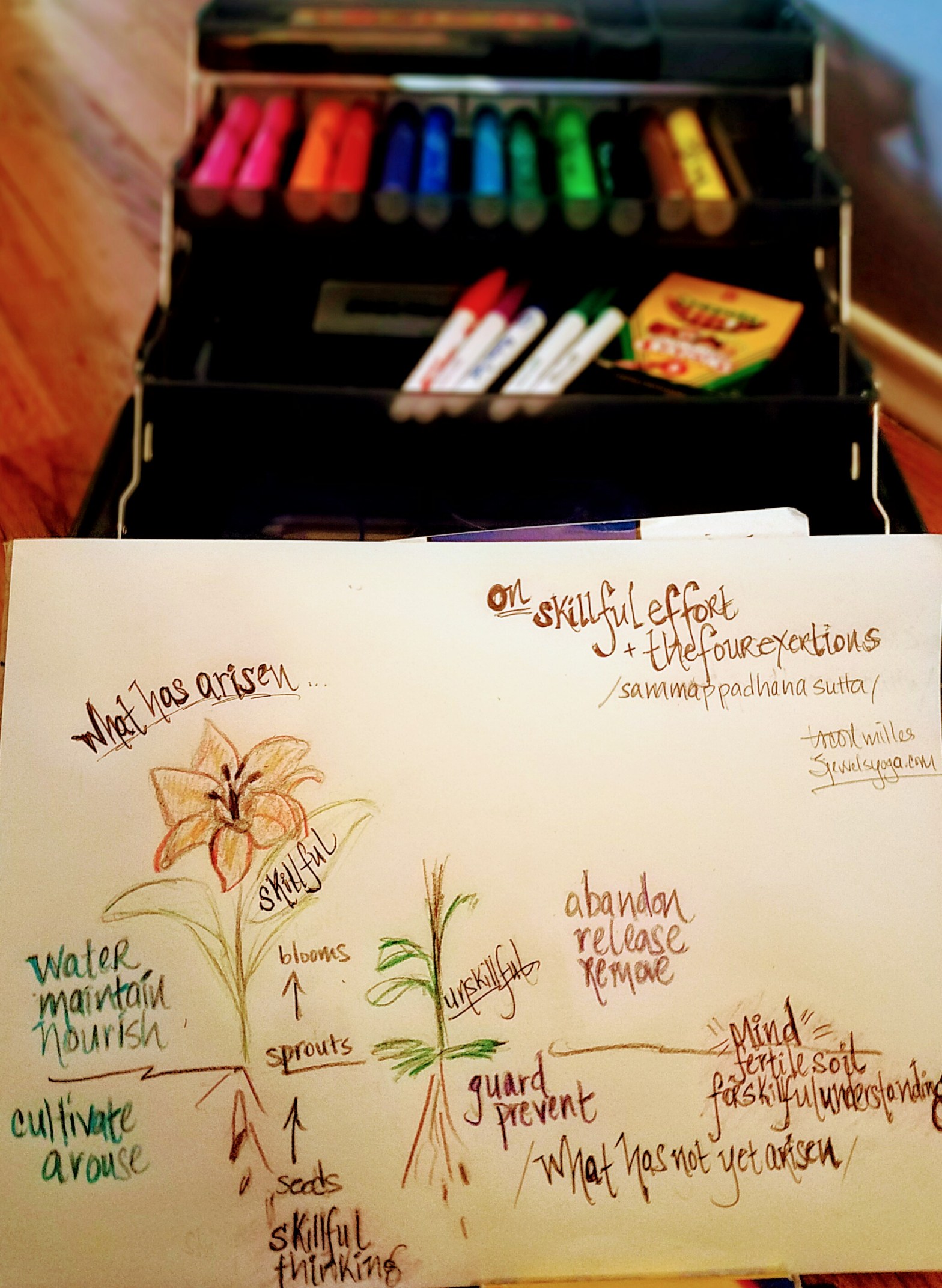
The featured image is my sketch of the Four Exertions, which inform our efforts to: cultivate skillfulness by watering and maintaining what has arisen while arousing or awakening skillfulness that has not yet arisen; and to transform unskillfulness by releasing and not dwelling in unskillfulness that has arisen while guarding against and not fueling that which has not arisen.
other liberating actions of the eightfold path
on skillful understanding + skillful thinking
on skillful speech, skillful action + skillful livelihood

 the strength of fingers, the might of earth.












 tscottmiller