earth day celebration: touching the earth

https://youtu.be/uRKAKO55URA

The practice of Touching the Earth is to return to the Earth, to our roots, to our ancestors, and to recognize that we are not alone but connected to a whole stream of spiritual and blood ancestors. We are their continuation and with them, will continue into the future generations. We touch the earth to let go of the idea that we are separate and to remind us that we are the Earth and part of Life.

~ excerpt from the Plum Village blog.
Read more about practice of Touching The Earth.

On “The Muddied Meaning of Mindfulness” | NYT.com

“Maybe the word “mindfulness” is like the Prius emblem, a badge of enlightened and self-satisfied consumerism, and of success and achievement…No one word, however shiny, however intriguingly Eastern, however bolstered by science, can ever fix the human condition. And that’s what commercial mindfulness may have lost from the most rigorous Buddhist tenets it replaced: the implication that suffering cannot be escaped but must be faced. Of that shift in meaning — in the Westernization of sati — we should be especially mindful.” ~VIRGINIA HEFFERNAN

Here I am this morning, preparing to share the practices with a group at our local law school, when this New York Times article pops up in my newsfeed!

When introducing mindfulness to the uninitiated, I am always clear about distinguishing its Buddhist origins–as an energy, a skill, a virtue among many others (like compassion, empathetic joy, trust, equanimity and loving-kindness) that we cultivate within our larger spiritual discipline–from its application as a secular/clinical “technique.”

For practitioners, it is not a trendy tool for self-improvement and is more than just a style of meditation. It is a vital foundation for living. How we think, speak, behave, and engage the world is filtered through the gates of mindfulness. It is one of the 5 Spiritual Faculties (or Powers) that we nourish alongside of trust, diligent effort, concentration and wisdom.

One does not have to become a Buddhist to authentically cultivate mindfulness. Yet many are concerned that as it becomes “sanitized” and popularized, it can also be mis-used and cause harm when not framed within the context of offering a deeper understanding of the teachings (i.e. The Foundations of Mindfulness/Satipatthana Sutta) and community-centered practice of Buddhism.

May all who integrate mindfulness benefit from it and may the fruits of their efforts benefit others.

Read the full article here:
The Muddied Meaning of Mindfulness

move like a goddess

move like a goddess

the invitation to move like a goddess is to inhabit your body
with full awareness.

to embrace its realities.

to tend to it in sickness and health!

to find physical activities that are meaningful and nourishing.

that don’t feel like drudgery or punishment.

that make you feel strong, healthy, capable, full of joy —
absolutely alive!

it is also an invitation to reflect on how we move through
a room, a situation, a day…our one and only life.

with head held high? with heart wide open?

grounded. centered. connected.


Awakening The Goddess : A Day of Refuge for Radical Self-Care
~ co-hosted by 3 Jewels Yoga + Sybil’s Healthy Way ~

Sunday, 19 July 2015 | 12 – 4 pm

REGISTER NOW at Sybil’s Healthy Way!

touching the earth: spring revival

image

whipping wind,

conductor and choreographer.

snow-bleached leaves lifted from the composting bed

into a swirling tornado ballet.

brittle and brown — some cracked with lacy veins of decomposition, some waxy-smooth and preserved.

all, frenzied and alive.

reanimated to dance upon the whistling breeze.

The Girl Who Got Up | TashmicaTorok.com

A truth about meditation: it can be uncomfortable or even excruciating, as my friend Tashmica so eloquently shares below.

First we meet the process of physically conditioning our bodies to find and sustain a steady posture (practice note: for me, “conditioning” means understanding how to take care of the tensions in the body not torturing ourselves to endure a rigid alignment that can create more distress). Holding the body through sitting meditation, in particular, takes time…just as training the body to walk a half marathon takes time, diligence and patience.

What we may be surprised to learn is that meditation is not “passive.” Rather, I’ve found it more accurate to frame meditation as I would yoga asana — in which we discover that the opposite of being active is not being passive; it is the more complex and dynamic energy of being receptive.

Sitting within the quiet space of receptivity, we open up to the possibility of encountering the hidden/neglected/protected parts of ourselves. With that, difficulties and discomforts may arise well before any insights or understanding that we may be longing for.

How, then, do we take care of ourselves through those moments when we discover that this practice, which is so often extolled for delivering peace, actually puts us face-to-face with the stunning reality that cultivating peace is a process…a training, not unlike a marathon. Tending to our hearts and minds requires our patience, diligence, and self-compassion.

I love that Tashmica is choosing not to give up but to keep getting up!

movement as meditation: learning to walk in peace (when sitting is not an option)

walking is always, always a good choice.
we were built to walk.
every location of every muscle and every shape of every bone
offers perfection in walking…
our bodies want to walk.
and with the body as in life,
we will find that what attracts us is in our own best interest.

~joy colangelo

It’s walk where you are 3been almost 15 years since I discovered that walking meditation was actually a thing! It happened quite spontaneously through the normal course of my day, trooping around New York City.
One moment I was mapping out errands and very likely puzzling out the “issue-of-the-day” related to grad school, work or relationships; and the next: I could only hear the sound of my breath and the rhythm of my boots on the pavement.

Everything else dropped away. The cacophony of the bustling neighborhood became a low humming in the background — alerting me of my surroundings but no longer as intrusive or overwhelming as it could be.

In the midst of the relentless “madness,” I felt surprisingly centered, clear and relaxed!

But it would still be years before I even stumbled across mention of walking (along with standing, lying down, and, of course the most commonly-known posture, sitting) as a form of meditation. “Ahhhh,” I thought. “So that’s what was happening?!”

Many moons later, I was introduced to the formal practice of walking meditation when I began studying the dharma with my root sangha. Those 20 minutes that we devoted to silently circumambulating the temple helped us transition from the hustle of the day into the quiet refuge of practice. Physically, it also helped to ease tension and to pbig sky mind.constellation2repare us to sit steadily in meditation for 20 minutes.

Beyond the temple walls, I’ve enjoyed walking meditation in yoga studios, at a labyrinth, on a park trail….and lately: around the rug in my living room!

So walk where you are to invite mindfulness and cultivate peace.

from cushion to community: spirituality at work

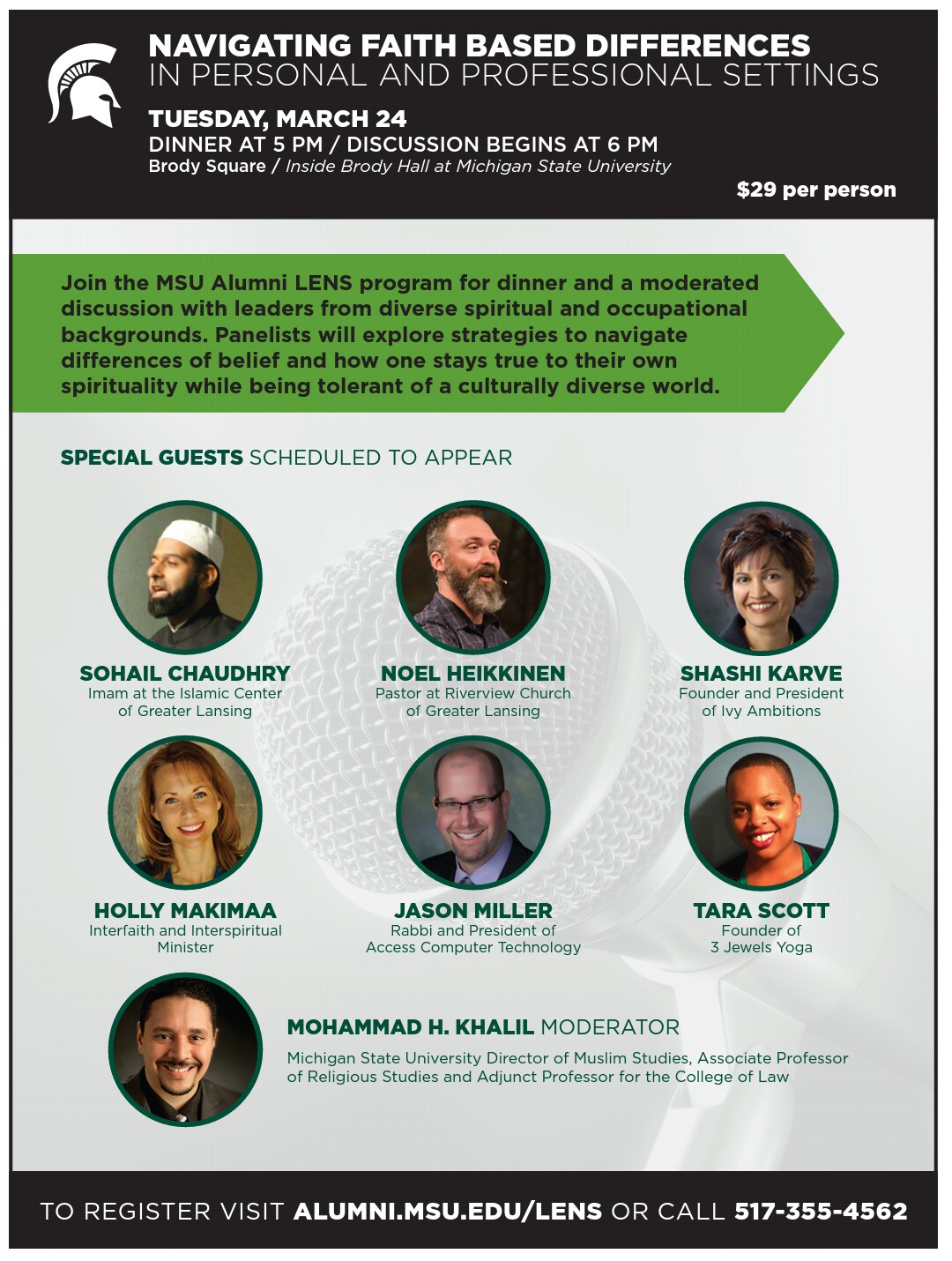
I’m thrilled to be a part of this interfaith conversation at Michigan State University on Tuesday, 24 March 2015. As I reflect on my work experiences — from retail to restaurants, grassroots to corporate offices in New York City and, for the last 9 years, in various wellness and spiritual settings — I am aware that in my younger days in the workforce my choice and ability to navigate differences in professional environments was influenced by the conditions and circumstances of the time. With wisdom and after witnessing a whole lot of “mess,” the decisions I make are driven by my principles and ethics. I seek alignment in all areas of my personal and professional — eliminating any disparities between how I tend to my livelihood and my life. I look forward to sharing insights and ideas with this diverse group of beings. image | Complete Event Details: http://alumni.msu.edu/programs/lens/courseSummary.cfm?activity=1417 | Livestream Info: http://new.livestream.com/msualumni/FAITH

March Mindfulness 2015

Today I kick off my annual ‪#‎MarchMindfulness‬ campaign to promote the practice of bringing skillful + compassionate awareness to how we engage, are impacted by, and then respond to the world around us.

The Satipatthana Sutta (Discourse on The Four Establishments of Mindfulness) is a foundational text and, ultimately, guiding practice in Buddhism. It is the inspiration and heart of my ‪#‎BodyAwarenessBootcamp‬ series, which ended this afternoon, and truly the ground in which my teaching practice is rooted.

How do we fully establish ourselves in mindfulness? We are diligent in developing a clear comprehension of the realities of our body and mind. It begins with the thread of the breath:

Breathing in,
be aware that [you] are breathing in.
Breathing out,
be aware that [you] are breathing out.

Breathing in,
be aware of [your] whole body.
Breathing out,
be aware of [your] whole body.

Throughout each day this month, let us take a few moments to immerse ourselves in this level of awareness and notice what moves, blooms, dissolves, transforms and even becomes reconciled in our body, mind and heart.‪ #‎RadicalActsOfSelfCare‬