

“When there is great doubt” says a Zen aphorism that Kusan Sunim kept repeating,”then there is great awakening. This is the key. The depth of any understanding is intimately correlated with the depth of one’s confusion. Great awakening resonates at the same “pitch” as great doubt. So rather than negate such doubt by replacing it with belief, which is the standard religious procedure, Zen encourages you to cultivate doubt until it “coagulates” into a vivid mass of perplexity…
Great doubt is not a purely mental or spiritual state: it reverberates throughout your body and your world. It throws everything into question. In developing doubt, you are told to question “with the marrow of your bones and the pores of your skin.” You are exhorted to “be totally without knowledge and understanding, like a three-year-old child.” To pose a question entails that you do not know something…To ask “What is this?” means you do not know what this is.
To cultivate doubt, therefore, is to value unknowing. To say ” I don’t know” is not an admission of weakness or ignorance, but an act of truthfulness: an honest acceptance of the limits of the human condition when faced with “the great matter of birth and death.” This deep agnosticism is more than the refusal of conventional agnosticism to take a stand on whether God exists or whether the mind survives bodily death. It is the willingness to embrace the fundamental bewilderment of a finite, fallible creature as the basis for leading a life that no longer clings to the superficial consolations of certainty.
~Stephen Batchelor, “Confessions of a Buddhist Atheist“

Sangha committed several months to the study of how we “live into community” and the purpose of gathering as spiritual friends to build our capacity for skillfulness and resilience. To that end, we’ve contemplated the Eightfold Path as a set of embodied practices that help us develop wisdom, ethical action, and various faculties that support our meditation.
The Eightfold Path is the fourth of the 4 Noble Truths:
There is Suffering.
There are Causes of Suffering (craving/attachment).
There is an End of Suffering.
The Noble Path is the End of Suffering.

Our journey on the Noble Eightfold Path winds up with three mental faculties — Skillful Effort, Skillful Mindfulness, and Skillful Concentration. With the development of our ability to regulate, shape, and direct the movements of our mind, we harness the power to cultivate and refine the first five “liberating” actions — our understanding, thinking, speech, action, livelihood — that help free us from cycles of suffering and discontent.
Skillful Effort refers to the quality of the energy we apply to our actions (both in meditation and in the world). Are we struggling, feeling sluggish, practicing half-heartedly and part-time, or wrestling with self-defeating patterns of doubt and worry that we’re not getting it right? Are we striving, approaching our practice ambitiously and overzealously, or straining ourselves with self-limiting habits of perfectionism or a goal-oriented mission for self-improvement?
Are we applying skillful understanding of how our brains and bodies function and of the conditions that create fluctuations in our energy so that we can be flexible, patient and gentle? Are we approaching our meditation practice and spiritual development with diligence — lovingly, compassionately, wholeheartedly, consistently, and creatively?
I highlight diligence here because in my study and practice of the 5 Spiritual Faculties, I discovered that, at its root (latin: diligere), it means “love, take delight in.” Whereas in common usage, we erroneously associate diligence with painstaking, rigorous or arduous work. So this re-claiming and re-imagining of how we use our energy resonates deeply with me. It feels more aligned with the quality of skillfulness, where we take care with how we apply ourselves — balancing the amount of stimulus and ease based on the conditions present — so that we are not creating habit energies of pursuit, ambition, craving, clinging or avoidance, resistance and aversion. And when those do arise, we are able to (re)examine them, readjust and transform them without criticizing or condemning ourselves.
Skillful Mindfulness may seem at first glance like a redundant term because we generally associate mindfulness with being a beneficial or at least “neutral” ability to pay attention. However, as we learn to pay attention to what is arising in body, heart, and mind, there is a possibility of our awareness taking a hue of criticism or hyper-vigilance that becomes unskillful. We lose the quality of ease, non-attachment, and non-judgment when we begin to ruminate or fixate on sensations, thoughts, emotions, perspectives.
Thus, cultivating the energy of skillfulness within our mindfulness is an invitation to ground ourselves in The Four Foundations of Mindfulness. The Buddhist discourse “Sutra on the Four Establishments of Mindfulness” (Satipatthana Sutta) details this thorough and measured process of liberating ourselves by abiding with full awareness of body and breath, feelings, mental states, and objects/qualities of the mind:
“A practitioner remains established in observation of the body in the body, diligent, with clear understanding, mindful, having abandoned every craving and every distaste for this life.
…remains established in observation of the feelings in the feelings, diligent, with clear understanding, mindful, having abandoned every craving and every distaste for this life.
…remains established in observation of the mind in the mind, diligent, with clear understanding, mindful, having abandoned every craving and every distaste for this life
…remains established in observation of the objects of mind in the objects of mind, diligent, with clear understanding, mindful, having abandoned every craving and every distaste for this life.”
— from Transformation + Healing by Thich Nhat Hanh
Skillful Concentration is understood as the mental capacity to merge skillful effort with skillful mindfulness to direct our attention toward a single-point of focus in our meditation practice. For example, we can cultivate steady focus on our breathing, by chanting a mantra, counting malas, gazing at a yantra or into candlelight.
Unfortunately, the dominant conception of being an experienced meditator is equated with being “successful” at concentrating and sitting stock-still for otherwordly periods of time. This idea is also upheld by teachers and practitioners who are fixated on being strict disciples of spiritual discourses written eons before science and technology would uncover the vast range of cognitive functioning. Lacking an understanding of neurodiversity, they promote a rigid “one size fits all brains” standard of learning.
As a homeschool educator and wife to a person living with a traumatic brain injury, I am keenly aware that favoring “concentration” as an optimal mental state and evaluative measure of progress in meditation (aka the flagstones of enlightenment) also presumes and privileges practitioners who have neurotypical development. So I’ve long been called to expand our perception and practice of concentration in order to minimize the anxiety and frustration that can arise in practitioners who have difficulty focusing. The invitation instead is to conjure the image of absorbing or being saturated with qualities we wish to embody like joy, equanimity, compassion, steadiness, nonattachment. We can then return to the Four Foundations of Mindfulness and contemplate the phyiscal sensations, emotions, thoughts, images, memories, narratives and experiences we associate with such attributes.
look deeply
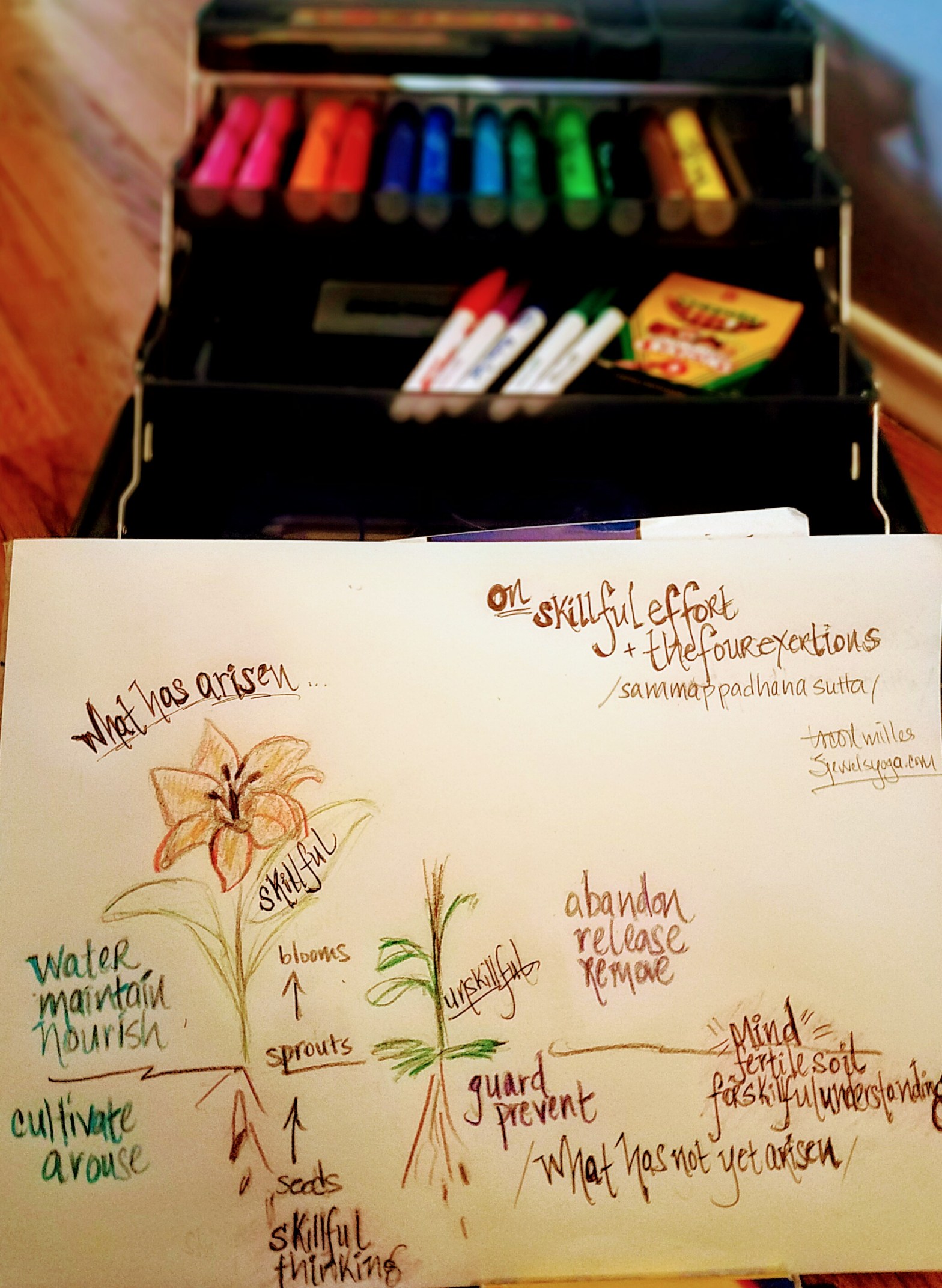
The featured image is my sketch of the Four Exertions, which inform our efforts to: cultivate skillfulness by watering and maintaining what has arisen while arousing or awakening skillfulness that has not yet arisen; and to transform unskillfulness by releasing and not dwelling in unskillfulness that has arisen while guarding against and not fueling that which has not arisen.
other liberating actions of the eightfold path
on skillful understanding + skillful thinking
on skillful speech, skillful action + skillful livelihood
We closed yesterday’s daylong practice of discernment and self-inquiry by reflecting on how we aspire to show up and carry what we have learned about cultivating radical bodhicitta — what I call the heart and mind of justice, liberation, and healing — into our ever-widening circles of compassionate social action.
After everyone departed, I returned to the room to collect my belongings and stood for a few breaths to rest and revel in the full energy we had collectively generated. In that sacred pause, I looked down at my stuff scattered around me — realizing that I was embodying the wisdom that framed the final segment of our discernment. Have your heart be where your feet are. I had spent the day exactly where my heart had called me to be.
When we value and intentionally cultivate the sacred pause, we can amplify our capacity to listen deeply to the call of our hearts and see clearly the direction our feet will go.
when(ever) + where(ever) we enter, may our hearts be where our feet are.

…we are in fact not where are feet are. We are not here. Or at least we are not all here.
The “where” that our heart is not so much a place but
a different time: past, and simultaneously, the future.
We are everywhere but in the now.
~Omid Safi
read Safi’s full column: Have Your Heart Be Where Your Feet Are
Revolution is not a one-time event.
It is becoming always vigilant for the smallest opportunity
to make a genuine change in established, outgrown responses;
for instance, it is learning to address each other’s difference with respect.
We share a common interest, survival, and it cannot be pursued in isolation
from others simply because their differences make us uncomfortable.We know what it is to be lied to.
The 60s should [have taught] us how important it is not to lie to ourselves.
Not to believe that revolution is a one-time event,
or something that happens around us
rather than inside of us.
Not to believe that freedom can belong to any one group of us
without others also being free.
How important it is not to allow even our leaders to define us to ourselves,
or to define our sources of power to us…Each one of us must look clearly and closely
at the genuine particulars (conditions) of his or her life
and decide where action and energy is needed
and where it can be effective.
~ Audre Lorde
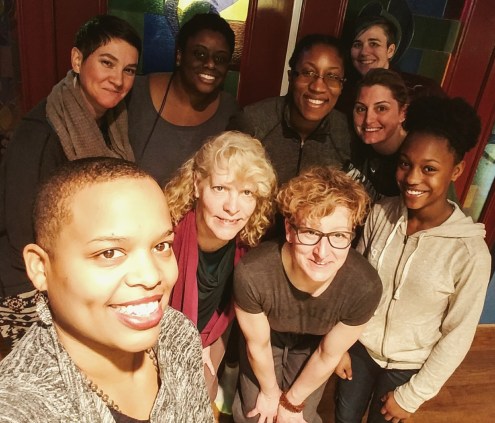
Post-Women’s March Deep Refuge + Restoration Circle
yesterday, we marched.
today we rest, take deep refuge and restore ourselves in the full embrace of sangha
to rise up and take action again.
~t. scott-miller
Join us in February, as we complete our three-month journey along the Noble Eightfold Path with a study the faculties of Skillful Effort, Skillful Mindfulness, and Skillful Concentration. The following month, we’ll deepen our contemplation of Justice, Liberation, and Healing — the focus of our annual call-to-action, March Mindfulness — and close out our winter series with a special full-day workshop on the topic on 3/19. View: Upcoming Practice Dates.

Fact: Many of us don’t carry cash.
Funny: The hilariously-creative alternative that was offered instead, with affection and sincerity I must add, by a friend wanted to honor the practice of generosity.
So, henceforth, let it be known that scratch-offs and books of stamps will gleefully be accepted as donations…psst, along with gift cards, sushi, and craft beer! Love my peeps for so many reasons, not the least of which is our sense of humor, subversiveness, and sacred irreverence.
I seriously roared with buddha-belly laughter and am still tickled by it!
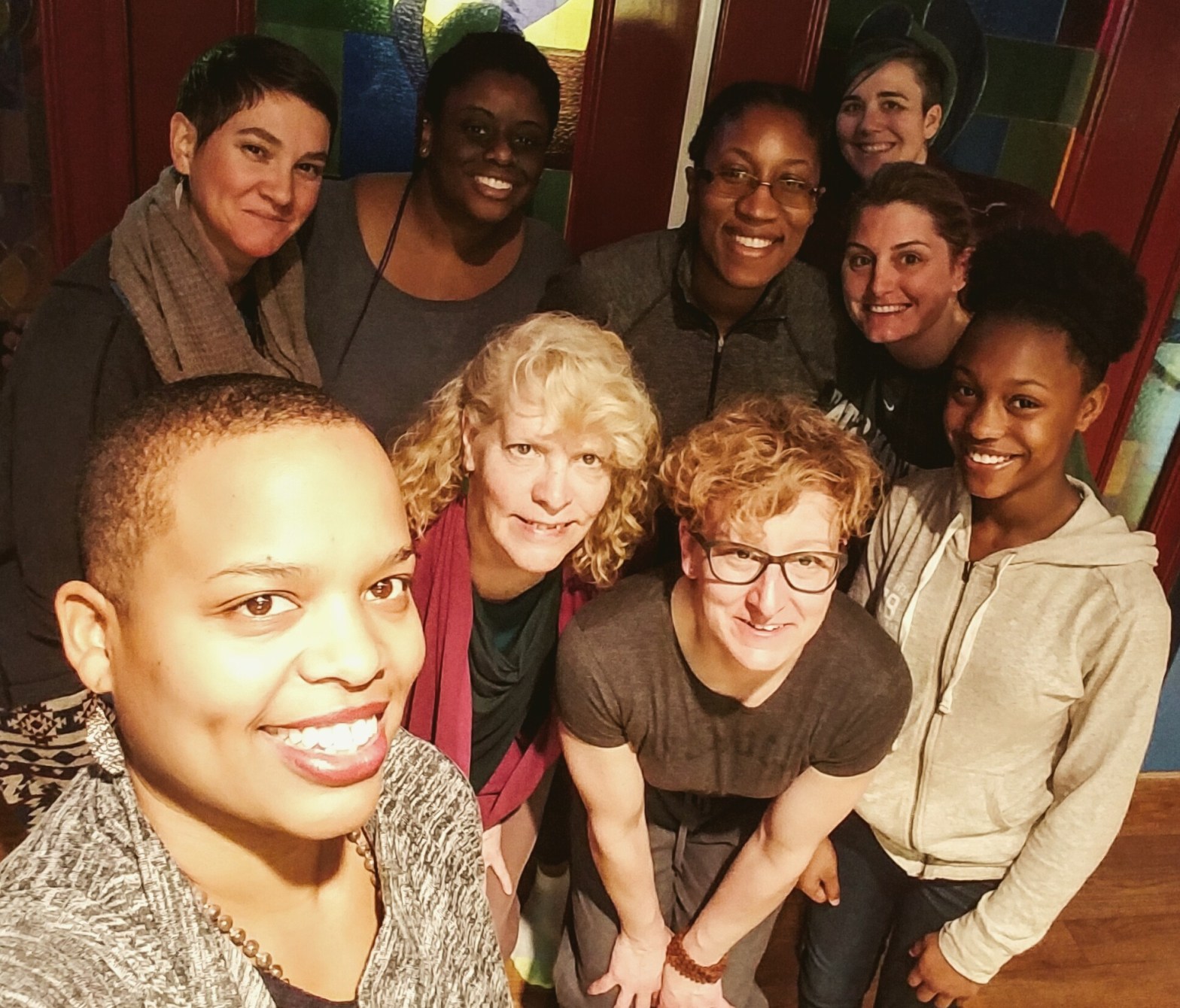
Harnessing the energy and light of the Women’s March in Washington as well our very own March on #LoveLansing, Sangha will draw closer together to shine our beacon of refuge, resistance, and restoration.
We gather at Heartdance Studio – 1806 E. Michigan Avenue. Doors open just before 11 am. Centering begins at 11:10-ish.
RSVP/UPDATES: 3 Jewels Yoga Sangha

Other Community Events:
14 January – National Day of Action for Flint | Capitol Building
17 January – Our Dream: Lansing United | Lansing Center
19 January – Ghostlight Project | Peppermint Creek Theatre
21 January – Children’s Social Justice Reading Group | East Lansing Public Library
21 January – Women Organize Michigan Summit

Sangha is studying how we “live into community” and the purpose of gathering as spiritual friends to build our capacity for skillfulness and resilience. To that end, we’re contemplating the Eightfold Path as a set of embodied practices that help us develop wisdom, ethical action, and various faculties that support our meditation.
The Eightfold Path is the fourth of the 4 Noble Truths:
There is Suffering.
There are Causes of Suffering (craving/attachment).
There is an End of Suffering.
The Noble Path is the End of Suffering.
The wisdom pair of Skillful Understanding and Skillful Thinking carries us to gates of the three ethical actions where we may examine how silence and discernment give shape and dimension to:
Skillful Speech — What we choose to say, how we choose to say it, and when we choose to say it. Speech is a form of action (the cause of karma) that is fueled by the quality of our understanding, thinking and intentions. It may be guided by factors that create a more skillful impact (the effect of karma) in the world.*
*(I use world here to encompass our daily encounters with people, places, and all manner of things.)
Skillful Action — How we choose to respond to the world as embodied in our conduct (direct/indirect; personal/interpersonal; private/public). The behaviors/activities we engage in and abstain from that reflect the quality of our understanding, thinking, and intentions.
Skillful Livelihood — I am compelled to expand livelihood beyond its common denotation as the work we do to earn a living. This is also coupled with a desire to suss out the snares of privilege and shame that arise when we narrow in on ethical employment without considering socio-cultural and economic factors that influence where and how we work. Looking deeply at the root meaning of the word itself unearths a broad view of how we cultivate our “way of life” and includes all the choices/actions we make to nourish and sustain a sense of living well (values, interests, experiences and relationships). Our livelihood then reflects and is informed by the quality of our understanding, thinking, intentions and actions.
Our contemplation draws on Audre Lorde’s essay, The Transformation of Silence into Language and Action:
What is the quality and impact of our silence?
Where does our silence show up as fear or avoidance?
When can it cause harm? When can it be a tool for healing?
Where can it be shaped into a tool of resistance — a healthy boundary to guard against toxic communication? A way of standing in our commitment to non-violent, compassionate action?
In what ways do we use meditation and practices of discernment as skillful means to transform silence into skillful speech and skillful action?
other liberating actions of the eightfold path
on skillful understanding + skillful thinking
on skillful effort, skillful mindfulness + skillful concentration
“In Buddhism, simply resting in a relaxed, open, spacious state of mind without purpose and without a goal is considered the highest form of spiritual practice…
This spacious awareness is considered both an advanced practice and a practice even the merest beginner can do.
This seems pa radoxical, but when a beginner does it, it has the quality and substance of a beginner’s awareness, and when an advanced meditator does it, it has a deeper quality of advanced awareness.
That is why I like to call it a prayer of silence. Prayer is not really something you get “good” at, like other skills — although people who pray regularly have cultivated a prayerful attitude toward life.
A prayer is in essence a surrender and
a supplication to that which is beyond ourselves.
In this sense the Buddhist practice of spacious awareness has a universality that makes it kindred with other religions.”
~ Lewis Richmond
Aging as a Spiritual Practice
[originally posted on 15 Dec 2013 on my former site dharma yoga arts]

there are no new ideas, just new ways of giving those ideas we cherish breath and power in our own living.
~ audre lorde
In a given season I cycle through a stack of books and frequently exchange “currently reading” snap shots with my circle of family and friends. What and when I read depends both on mood/instinct and whose voice/ideas feel most compelling. It is a discernment that inevitably leads to discovering the message I most needed to hear!
This list comprises books that were long-ago gifted or recently rediscovered that I am re-reading(*) with fresh eyes after many years. Others were recommended or “manifested” at the right time — namely, from the juju-magick of a kiosk at my local library branch where books I don’t even know I’m looking for seem to auspiciously materialize as I pass by!


 tscottmiller