#WholyHappyHour [11/22]: Continuing The Practice of Self-Compassion

Throughout this new season, our study and practice will be devoted to learning to hold space for ourselves and others in order to build trust, safety, skillful understanding and compassion in our spiritual community and in all relationships.

Nov 22nd | 11 AM – 12:30 PM at Heartdance Studio.

Self-Compassion provides the fuel for sustaining our own well-being so that we can be solid, whole, and free when called to serve others. At our practice earlier this month, we looked deeply into the factors of self-compassion and set the intention to gift ourselves with daily doses of kindness in creative and sustainable ways.

What does self-compassion look like in real time? How do we conjure this energy beyond the meditation cushion and the sacred circle of sangha where the conditions for shamatha–stopping, abiding in silence and stillness–seem more attainable and the arising sense of gratitude, calm, and well-being feel more palpable?

It begins with a commitment to develop an intimate relationship with ourselves. To practice taking ourselves as the object of love! If only for 15 minutes, block out time for self-tending throughout each day.

  • Create a personal peace treaty.* Write a note of vows, activities, mantras, or affirmative statements that remind you to be gentle and generous with yourself. 
  • Spend time in solitude enjoying activities that feel nourishing and restore or boost yourself sense of peace and well-being.
  • Whenever you hit a rough patch and feel overwhelmed, frustrated or sad, give yourself the freedom to acknowledge those thoughts and feelings. Shine the light on them. Breathe into them, creating space for them to disperse and dissipate. Release judgment. Do not succumb to the temptation of panic or despair, as dharma teacher Jack Lawlor recently encouraged at our annual Day of Mindfulness)! Take refuge in the wisdom of the breath–the flowing change and steadiness in tempo with life itself–to hold you moment to moment. Nowhere to go, nothing to do, nothing to attain, no one to be. No struggling, striving, fixing. Simply abiding where you are. See what changes when you take care of your suffering with tenderness.
  • Relax in the company of good spiritual friends who model healthy self-tending practices and can offer wise counsel and support.

As we practice looking and listening deeply to examine our aspirations, fears, gifts, wounds, misperceptions, and values, we create the conditions for developing clear and skillful understanding. Buddhist practice celebrates curiosity and openness by inviting us to repeatedly and gently ask: “What is this?” and “Are you sure?” By studying ourselves in this waywe can penetrate the causes of our suffering and identify our suchness–all the wondrous, mysterious, and quirky elements that make up our nature.

From this diligent effort grows respect, which holds at its very root the wise instruction to look back at! So we give ourselves the time and space to see ourselves completely: our history, our habits, our humanness. We keep turning back, again and again, to look inward at how we relate to ourselves and engage the world around us. We discern the skillful means to make compassionate actions and transform unskillful thoughts we hold about ourselves and unskillful behaviors that reinforce our suffering.

Notes + Related Readings:

  • In Creating True Peace, Thich Nhat Hanh suggests this exercise for couples in moments of conflict and lists skillful actions for both “one who is angry” and “the one who has made the other angry” such “refrain from saying or doing anything that might cause further damage or escalate the anger” and “respect the other person’s feelings, not ridicule him or her, and allow him or her enough time to calm down.”
  • Awakening The Voice of Self-Love [3 Jewels Yoga].
  • Teachings on Love by Thich Nhat Hanh.


ON THE HORIZON:

Dec 6th | 11 AM – 12:30 PM ~ #WholyHappyHour: Taking Refuge in the Island of The Self [Practice I]3 Jewels Yoga Sangha at Heartdance Studio.

Dec 9th | 7  – 9 PM ~ Leading Dharma Talk on Healing the Past at Lansing Area Mindfulness Community – Van Hanh Temple, 3015 S. Washington Ave.

Dec 20th | 11 AM – 12:30 PM ~ #WholyHappyHour: Taking Refuge in the Island of The Self [Practice I]. 3 Jewels Yoga Sangha at Heartdance Studio.

Jan 10th | 11 AM – 12:30 PM ~ #WholyHappyHour: TBD. 3 Jewels Yoga Sangha at Heartdance Studio.

#WholyHappyHour [11/8]: Self-Compassion

Throughout this new season, our study and practice will be devoted to learning to hold space for ourselves and others in order to build trust, safety, skillful understanding and compassion in our spiritual community and in all relationships.

Self-Compassion provides the fuel for sustaining our own well-being so that we can be solid, whole, and free when called to serve others.

Check out these images + ideas on being kind to yourself:

3jewels.restorepeace

ON THE HORIZON:

Nov 15th | 1:00 PM – 3:00 PM ~ Conscious + Fit: Building Body Awareness at Heartdance Studio.

Nov 22nd | 11 AM – 12:30 PM ~ #WholyHappyHour: 3 Jewels Yoga Sangha at Heartdance Studio.
Dec 6th | 11 AM – 12:30 PM ~ #WholyHappyHour: 3 Jewels Yoga Sangha at Heartdance Studio.
Dec 20th | 11 AM – 12:30 PM ~ #WholyHappyHour: 3 Jewels Yoga Sangha at Heartdance Studio.
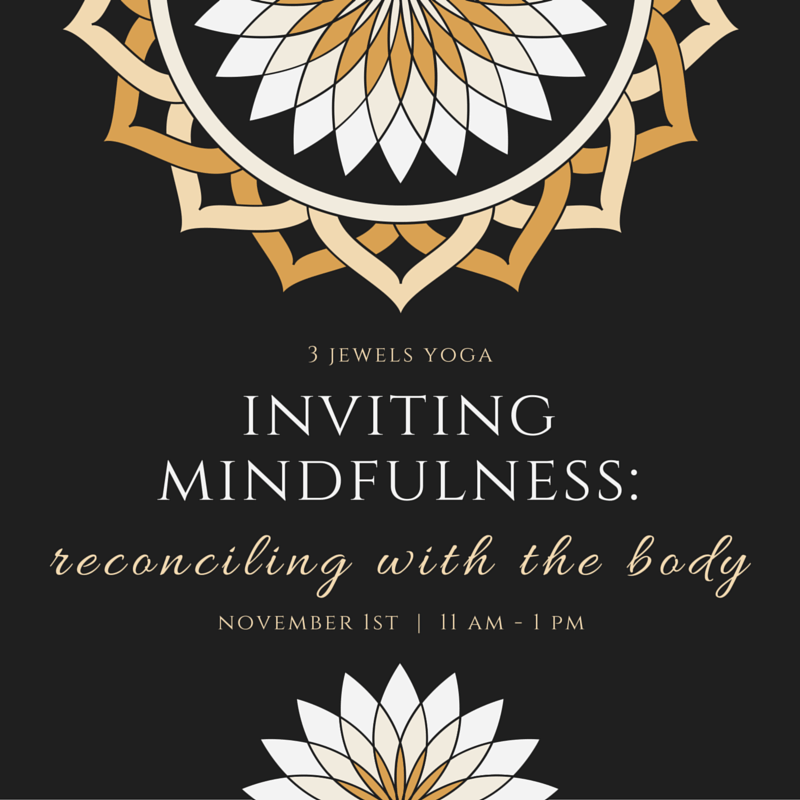
Special Event [Nov 1st]: Inviting Mindfulness: Reconciling With The Body

invitingmindfulness.reconcilingbody

20/person through October 20
25/person after October 20

REGISTER NOW: Just B Yoga Workshops


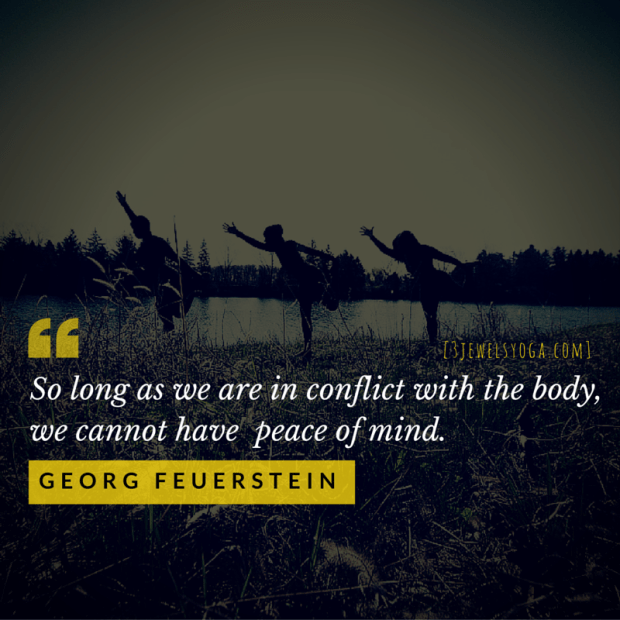
So long as we are in conflict with the body,
we cannot have peace of mind.
~ Georg Feuerstein

Reconciling with the Body is a practice of learning to acknowledge, witness, accept and embrace our body as it is in this moment.

We learn to inhabit our body with the full awareness of its nature to change — to age, to become ill or injured, and to experience limitations.

We learn to take care of the difficult feelings that arise in the face of these changes and to tend to ourselves with great tenderness.

We look deeply into our self-perceptions and, with diligent effort, patience and kindness, begin to release beliefs that are harmful or no longer true.

From this place of skillful understanding, we can explore our capacity to nourish ourselves with meaningful movements that restore or inspire new ways of seeing, thinking about, and caring for our bodies.

embodied practice: Zenju’s Meditation on Surviving Acts of Hatred

In the wake of the Charleston massacre, I led a dharma discussion for my sangha, Lansing Area Mindfulness Community, on being ‪‎good spiritual friends‬ and reflected on ways we can take care of ourselves and one another in the face of racism, bias, and injustice. I shared passages from Zenju Earthlyn Manuel’s book, The Way of Tenderness, which I had been studying since its release last winter, and invited all to deeply penetrate the body as nature:

“Seeing body as nature is to directly see form
as nature, as of the earth.

It is to see the pure form of life without the distortions…
Rage springs up when certain embodied forms of life–blackness, queerness, and so on
–are not recognized and honored as part of nature.”

Once again, Zenju offers healing wisdom through an embodied practice of breathing. I hope you will share this far and wide with others who are seeking to reconcile with and find refuge within the body…as nature, as home:

“May the great light of this Earth surround me,
May I be released from past harm and imposed hatred.
May I come to recognize my existence in the true nature of life.
May I come back to this breath, to this body,
as the sacred place in which I remain awake

and connected to the fragrance and taste of liberation.”

May our healing continue…

Read Zenju’s full post here:  I Can Breathe: A Meditation on Surviving Acts of Hatred

HEAR HERE [for deep listening]: Opening The Question of Race to the Question of Belonging | On Being with Krista Tippett

And I think being human is about being in the right kind of relationships. I think being human is a process. It’s not something that we just are born with. We actually learn to celebrate our connection, learn to celebrate our love. And the thing about it — if you suffer, it does not imply love. But if you love, it does imply suffering. So part of the thing that I think what being human means to love and to suffer, to suffer with, though, compassion, not to suffer against. So to have a space big enough to suffer with. And if we can hold that space big enough, we also have joy and fun even as we suffer. And suffering will no longer divide us. And to me, that’s sort of the human journey.
~ john a. powell

I was invited to facilitate a dharma discussion for my root sangha to address the wellspring of emotions and concerns members have expressed following the tragedy in Charleston last week. Drawing on the Four Foundations of Mindfulness, I entitled the talk “Good Spiritual Friends: Taking Care of Ourselves & One Another in the Face of Racism, Bias, & Injustice” and asked that we actively investigate our own perceptions, intentions and behaviors as we reflect on how to apply and cultivate the dharma in response to such devastation. We expressed our confusion, anger, shame, fear, helplessness, outrage. We cried. We breathed. We sat with our discomfort. 

I asked that we continue to find refuge in practices that help to nourish and ground us as well as those that illuminate unskilfulness, awaken clear comprehension, and inspire compassionate actions.

That sweet space of refuge is fleeting: Our hearts burst open with the victory of the Marriage Equality Act last Friday. Then they are crushed once more with every church that goes up in flames at the hands of racist terrorists. 

For sanity and nourishment, I am mindful about what I consume–attempting to combat this madness by sharing this dose of sustenance (clear, compassionate understanding) for the mind and soul.

Hear Here: john a powell ~ Opening the Question of Race to the Question of Belonging

KnowTheirNames
artist: sarah green

The Girl Who Got Up | TashmicaTorok.com

A truth about meditation: it can be uncomfortable or even excruciating, as my friend Tashmica so eloquently shares below.

First we meet the process of physically conditioning our bodies to find and sustain a steady posture (practice note: for me, “conditioning” means understanding how to take care of the tensions in the body not torturing ourselves to endure a rigid alignment that can create more distress). Holding the body through sitting meditation, in particular, takes time…just as training the body to walk a half marathon takes time, diligence and patience.

What we may be surprised to learn is that meditation is not “passive.” Rather, I’ve found it more accurate to frame meditation as I would yoga asana — in which we discover that the opposite of being active is not being passive; it is the more complex and dynamic energy of being receptive.

Sitting within the quiet space of receptivity, we open up to the possibility of encountering the hidden/neglected/protected parts of ourselves. With that, difficulties and discomforts may arise well before any insights or understanding that we may be longing for.

How, then, do we take care of ourselves through those moments when we discover that this practice, which is so often extolled for delivering peace, actually puts us face-to-face with the stunning reality that cultivating peace is a process…a training, not unlike a marathon. Tending to our hearts and minds requires our patience, diligence, and self-compassion.

I love that Tashmica is choosing not to give up but to keep getting up!

March Mindfulness 2015

Today I kick off my annual ‪#‎MarchMindfulness‬ campaign to promote the practice of bringing skillful + compassionate awareness to how we engage, are impacted by, and then respond to the world around us.

The Satipatthana Sutta (Discourse on The Four Establishments of Mindfulness) is a foundational text and, ultimately, guiding practice in Buddhism. It is the inspiration and heart of my ‪#‎BodyAwarenessBootcamp‬ series, which ended this afternoon, and truly the ground in which my teaching practice is rooted.

How do we fully establish ourselves in mindfulness? We are diligent in developing a clear comprehension of the realities of our body and mind. It begins with the thread of the breath:

Breathing in,
be aware that [you] are breathing in.
Breathing out,
be aware that [you] are breathing out.

Breathing in,
be aware of [your] whole body.
Breathing out,
be aware of [your] whole body.

Throughout each day this month, let us take a few moments to immerse ourselves in this level of awareness and notice what moves, blooms, dissolves, transforms and even becomes reconciled in our body, mind and heart.‪ #‎RadicalActsOfSelfCare‬

The Women We Are [promo video]: Community Conversation “On Reconciling With The Body”

How can we cultivate the voice of self-love and devote ourselves to radical acts of self-care?
How do we tend to ourselves through the reality of our aging, changing bodies?
How can we learn to take refuge in our bodies and reclaim beauty, wellness, and strength in our own terms?

Join us on Thursday, 19 February, at 7 pm for a compassion-filled, community-centered conversation
on reconciling with the body and seeing ourselves whole!

The Women We Are is a documentary portrait project created by Amanda Grieshop.
Learn more about her work at Magpie Imagery.