on refuge + resistance | today we march

Reclaim. Resist. Rise Up! For Justice. For Equity. For A Future To Be Possible. #MarchOnWashington #MarchOnLansing #SisterMarch

#WhyIMarch

For those who came before me — for their sacrifices, suffering, and will to survive.

It’s in my DNA to give a damn!

embody privilege and risk as an educated cis-hetero black woman who is the daughter of an immigrant, a mother to a multi-ethnic child, a wife in an interfaith, inter-racial marriage to a survivor of gun violence who lives with a disability.

I cannot, do not, will not co-sign craziness.

For my beloveds and for all the beloveds in generations to come to inherit an Earth that has been restored to wholeness and where integrity, compassion, wisdom, creativity, and deep listening are society’s leading values .

To call out unmitigated and unexamined whiteness, which in its denial of privilege and  refusal to take accountability for oppressions and inequities, creates a toxicity that corrodes what unites us.

Because corruption and complacency are killing us.

To build our capacity as a spiritually resilient community that cultivates and protects justice, freedom, and equity through compassionate, creative, innovative and skillful understanding and actions.

To be a beacon of light as a community of refuge and resistance against hate, violence, inequity and oppression.

For Justice, Liberation + Healing!

Today, we march. Tomorrow, we rest, take refuge and restore ourselves to rise up and to take action again.

the suchness of sangha | sacred irreverence

I ❤ Sangha! #ZenHumor

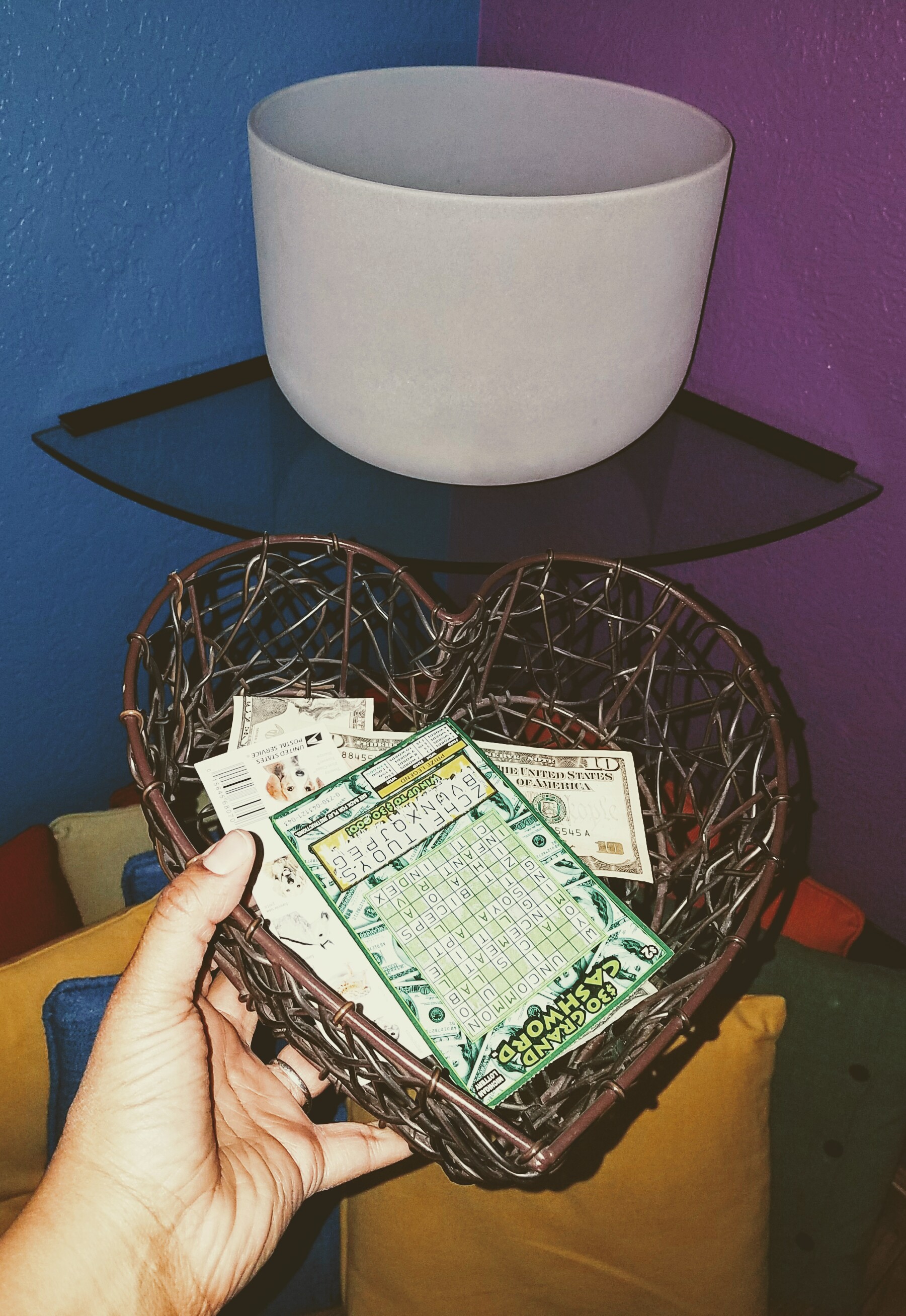
Fact: Many of us don’t carry cash.

Funny: The hilariously-creative alternative that was offered instead, with affection and sincerity I must add, by a friend wanted to honor the practice of generosity. 

So, henceforth, let it be known that scratch-offs and books of stamps will gleefully be accepted as donations…psst, along with gift cards, sushi, and craft beer! Love my peeps for so many reasons, not the least of which is our sense of humor, subversiveness, and sacred irreverence. 

I seriously roared with buddha-belly laughter and am still tickled by it!

on refuge + resistance | reclaiming king’s dream

3jewels.tsm.werk.png

We begin this historic week with the commemoration of Dr. Martin Luther King Jr. and the National Day of Racial Healing as we trudge toward the final day that our country’s first Black president, Barack Obama, will stand as head of state. Fueled and aflame, with our hearts and minds resting on justice, liberation and healing, we take refuge in the good works, legacy, and words of wisdom from emissaries of light.

In intimate circles, we draw closer, lean into, speak truths and listen deeply to one another — resisting the temptation to be pulled under by despair, fear, hate, and hopeless.  En masse, we gather, convene, rally, and march — using our voices and bodies to resist the normalization of this new swell of injustice and violence that seeks to impoverish, divide, and oppress us. Wherever we are, we reclaim the integrity of King’s vision: to stand firmly in our commitment to serve, liberate, heal, love and cultivate, demand, and protect justice and equity in order to restore ourselves and our communities to wholeness.

_________________________

“You may well ask: “Why direct action? Why sit ins, marches and so forth? Isn’t negotiation a better path?”

You are quite right in calling for negotiation. Indeed, this is the very purpose of direct action. Nonviolent direct action seeks to create such a crisis and foster such a tension that a community which has constantly refused to negotiate is forced to confront the issue. It seeks so to dramatize the issue that it can no longer be ignored. My citing the creation of tension as part of the work of the nonviolent resister may sound rather shocking. But I must confess that I am not afraid of the word “tension.”

I have earnestly opposed violent tension, but there is a type of constructive, nonviolent tension which is necessary for growth. Just as Socrates felt that it was necessary to create a tension in the mind so that individuals could rise from the bondage of myths and half truths to the unfettered realm of creative analysis and objective appraisal, so must we see the need for nonviolent gadflies to create the kind of tension in society that will help men rise from the dark depths of prejudice and racism to the majestic heights of understanding and brotherhood.

The purpose of our direct action program is to create a situation so crisis packed that it will inevitably open the door to negotiation. “

Dr. Martin Luther King Jr.
Letter from a Birmingham Jail


#ReclaimMLK

Movement for Black Lives ~
Resist + Reclaim   |   
Schedule of Actions

March on Lansing ~
What We Stand For

Mashable ~ 8 Quotes

Take Part ~
‘Reclaim MLK’ Protesters Kick Santitized King Ideology to the Curb

Zenju ~
Now Is The Time We Have Been Waiting For

from the 3 Jewels Yoga dhamma shelf
toward wholeness: nurturing interdependence in honor of mlk jr

touching the earth | reflections on zenju’s “way-seeking mind of martin luther king jr.”

special sangha event [1/22]: deep refuge + restoration circle

Harnessing the energy and light of the Women’s March in Washington as well our very own March on #LoveLansing, Sangha will draw closer together to shine our beacon of refuge, resistance, and restoration.

Living Into Community, Building Our Capacity with the Noble Eightfold Path.

11 am – 12:30 pm | Meditation + Dharma Discussion

12:30 – 2:00 pm | Feast + Fellowship Circle

We gather at Heartdance Studio – 1806 E. Michigan Avenue. Doors open just before 11 am. Centering begins at 11:10-ish.

RSVP/UPDATES3 Jewels Yoga Sangha

Enter a caption

Other Community Events:

14 January – National Day of Action for Flint | Capitol Building

17 January – Our Dream: Lansing United | Lansing Center

19 January – Ghostlight Project | Peppermint Creek Theatre

21 January – Children’s Social Justice Reading Group | East Lansing Public Library

21 January – Women Organize Michigan Summit

the eightfold path: on skillful speech, skillful action + skillful livelihood

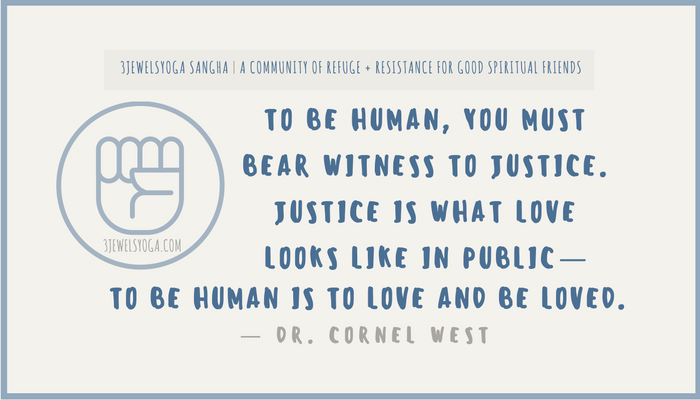
3jewels-cwestquote

Sangha is studying how we “live into community” and the purpose of gathering as spiritual friends to build our capacity for skillfulness and resilience. To that end, we’re contemplating the Eightfold Path as a set of embodied practices that help us develop wisdom, ethical action, and various faculties that support our meditation.

The Eightfold Path is the fourth of the 4 Noble Truths:

There is Suffering.
There are Causes of Suffering (craving/attachment).
There is an End of Suffering.
The Noble Path is the End of Suffering.


The wisdom pair of Skillful Understanding and Skillful Thinking carries us to gates of the three ethical actions where we may examine how silence and discernment give shape and dimension to:

Skillful Speech — What we choose to say, how we choose to say it, and when we choose to say it. Speech is a form of action (the cause of karma) that is fueled by the quality of our understanding, thinking and intentions. It may be guided by factors that create a more skillful impact (the effect of karma) in the world.*

*(I use world here to encompass our daily encounters with people, places, and all manner of things.)

Skillful Action — How we choose to respond to the world as embodied in our conduct (direct/indirect; personal/interpersonal; private/public). The behaviors/activities we engage in and abstain from that reflect the quality of our understanding, thinking, and intentions.

Skillful Livelihood — I am compelled to expand livelihood beyond its common denotation as the work we do to earn a living. This is also coupled with a desire to suss out the snares of privilege and shame that arise when we narrow in on ethical employment without considering socio-cultural and economic factors that influence where and how we work. Looking deeply at the root meaning of the word itself unearths a broad view of how we cultivate our “way of life” and includes all the choices/actions we make to nourish and sustain a sense of living well (values, interests, experiences and relationships). Our livelihood then reflects and is informed by the quality of our understanding, thinking, intentions and actions.

Our contemplation draws on Audre Lorde’s essay, The Transformation of Silence into Language and Action:

What is the quality and impact of our silence?
Where does our silence show up as fear or avoidance?
When can it cause harm?  When can it be a tool for healing? 

Where can it be shaped into a tool of resistance — a healthy boundary to guard against toxic communication?  A way of standing in our commitment to non-violent, compassionate action?
In what ways do we use meditation and practices of discernment as skillful means to transform silence into skillful speech and skillful action?


other liberating actions of the eightfold path

on skillful understanding + skillful thinking
on skillful effort, skillful mindfulness + skillful concentration


happy 2017 | beginning anew on the noble eightfold path


Sangha enters the New Year by continuing our steady journey along the Noble Eightfold Path:

8 January | Beginning Anew + Skillful Speech (part II)
15 January | Skillful Action
22 January | Skillful Livelihood

5 February | Skillful Effort
12 February | Skillful Mindfulness
19 February | Skillful Concentration


a look back:

on skillful understanding + skillful thinking
on skillful communication

a look forward:

full winter schedule


criteria for skillful communication

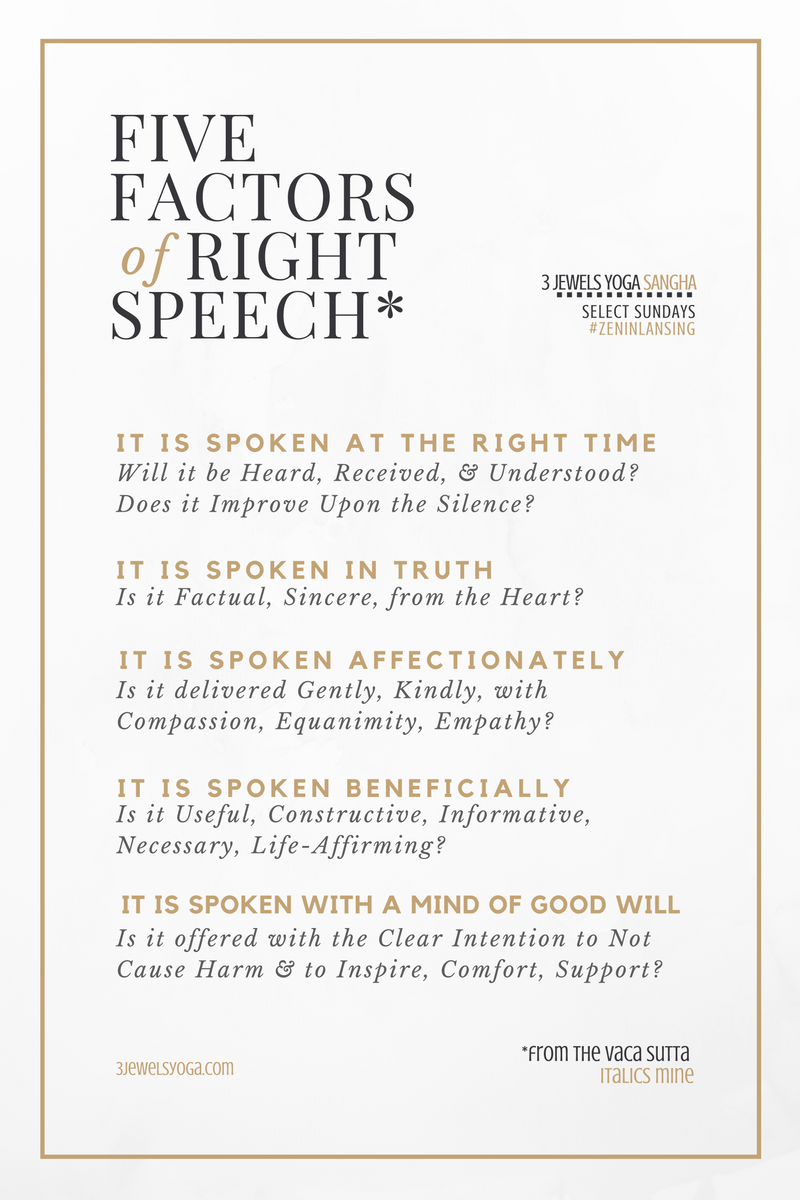
3jewels-vacasutta

Last December, I was invited to give a presentation to fellow members of my local Facilitators Guild on the 4 Gates of Speech after referencing them in one of our monthly meetings. As I prepared, I discovered overlapping ideas across various wisdom traditions and expanded my presentation into a list of Criteria for Skillful Communication below. 


Cultivating skillful communication is more than an intellectual endeavor. It is an embodied mindfulness practice comprised of Deep Listening and Skillful Speech.

We learn to listen deeply by paying attention to our thoughts, perceptions, bodily sensations, and emotions while listening to others and while speaking. Through this process, we can discern what to say, how to say it, and when, if at all, to say it–which is the foundation for impeccable speech.

Intention: To foster understanding and compassion.

Actions: Draw upon silence in order to give full awareness to our experience in the moment and to reflect on our speech before, during, and after speaking.

__________

Before speaking, let your words pass through these gates.
__________

Origins in Philosophical + Wisdom Traditions

I. 3 Sieves/3 Filters ~ Attributed to multiple sources (i.e. Socrates, Quakers, poets).

Is it True?
Is it Kind?
Is it Necessary/Useful?

II. 4 Gates of Speech ~ Possibly Sufi; misattributed to Buddhism.

Is it True?
Is it Necessary?
Is it Helpful?
Is it Kind?

III. 5 Factors of Right Speech ~ Buddhist; from the Vaca Sutta (italicized text mine).

It is spoken at the right time.
Will it be Heard, Received and Understood? Does it Improve Upon the Silence?

It is spoken in truth.
Is it Factual, Sincere, from the Heart?

It is spoken affectionately.
Is it delivered Gently, Kindly, with Compassion, Equanimity, Empathy?

It is spoken beneficially.
Is it Useful, Constructive, Informative, Necessary, Life-Affirming?

It is spoken with a mind of good-will.
Is it offered with the Clear Intention to Not Cause Harm, to Inspire, to Comfort, to Support?

[16 December 2015]


in the dharma circle

So what does this look like in action? Following our meditation practice, Sangha exercises the capacity for skillful communication through a discussion on a selected topic of contemplation.

Our skillful speech has the opportunity to become refined by three factors: silence, bowing (gassho), and breath.  

We speak from discerning through silence — using the sacred pause to garner clarity of thought/feeling and to measure those formations alongside the (3, 4, or 5) criteria named above.

We bow when we wish to speak. Sangha bows in return.
It is an embodiment of our commitment, as speakers, to speak skillfully and, as listeners, to listen deeply in order to cultivate our skillful understanding of what will be shared. 

We bow again at the completion of our sharing. Sangha bows in return.
It is an embodiment of our commitment to give space for understanding to unfold and for discerning whether to contribute a subsequent insight, question, or experience.

We pause and breathe, for at least 3 full cycles, to center and ground ourselves before contributing to the dharma circle.

The pausing, bowing, and breathing not only bridge the sacred energy of mindfulness to the practical aspect of turn-taking. But these practices also disrupt common communication patterns and de-condition our habits of interrupting, cross-talking, or sparking side conversations.

Whichever of the 3 Sieves, 4 Gates, or 5 Factors resonates most with you, use these criteria to gauge the quality of your awareness and ensuing impulses to respond when holding conversations. It can be jarring for practitioners who intentionally cultivate deep listening and skillful speech to recognize how wide the gap is between how we experience and participate in communication inside and outside of the dharma circle.

on kindred practices: prayer, silence + spacious awareness

“In Buddhism, simply resting in a relaxed, open, spacious state of mind without purpose and without a goal is considered the highest form of spiritual practice…

This spacious awareness is considered both an advanced practice and a practice even the merest beginner can do.

This seems pamudra 2.bw (640x480)radoxical, but when a beginner does it, it has the quality and substance of a beginner’s awareness, and when an advanced meditator does it, it has a deeper quality of advanced awareness.

That is why I like to call it a prayer of silence. Prayer is not really something you get “good” at, like other skills — although people who pray regularly have cultivated a prayerful attitude toward life.

A prayer is in essence a surrender and
a supplication to that which is beyond ourselves.

In this sense the Buddhist practice of spacious awareness has a universality that makes it kindred with other religions.”

Lewis Richmond
Aging as a Spiritual Practice


[originally posted on 15 Dec 2013 on my former site dharma yoga arts]

on the dharma shelf | december 2016

there are no new ideas, just new ways of giving those ideas we cherish breath and power in our own living.

~ audre lorde 

In a given season I cycle through a stack of books and frequently exchange “currently reading” snap shots with my circle of family and friends. What and when I read depends both on mood/instinct and whose voice/ideas feel most compelling. It is a discernment that inevitably leads to discovering the message I most needed to hear!  

This list comprises books that were long-ago gifted or recently rediscovered that I am re-reading(*) with fresh eyes after many years. Others were recommended or “manifested” at the right time — namely, from the juju-magick of a kiosk at my local library branch where books I don’t even know I’m looking for seem to auspiciously materialize as I pass by!

  • Sister Outsider | Audre Lorde
  • Reading the Bible Again for the First Time | Marcus J. Borg
  • The Gilda Stories* | Jewelle Gomez
  • Just Mercy: A Story of Justice + Redemption | Bryan Stevenson
  • Radical Dharma: Talking Race, Love, + Liberation | Rev. angel Kyodo williams, Lama Rod Owens, Jasmine Syedullah
  • How To Free Your Mind: Tara the Liberator* | Thubten Chodron

on the danger of delusion + co-signing craziness

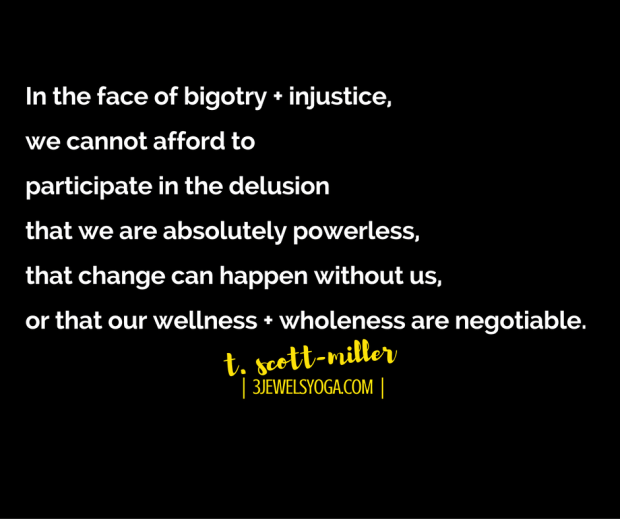
3jewels-cuttingthroughdelusion

Requiem: Prelude, Coda, Encore 

This. Againa million hoodies, a million hearts: metta behind the movement for trayvon martin.

I didn’t know where to physically place this section in the body of this writing. An overlapping marker on the timestream — the beginning, the end, the looping back to repeat for impact and emphasis — it wasn’t a part of the original thought-piece (consciously, anyway).

Read it as you will: first, for a sneak peek; or last as a behind-the-scene bonus. Either way, I offer it as insight into process and synchronicity.

Eager though I was to get these pressing thoughts out of my head, there is something to be said for respecting intuition. For cultivating shamatha. Pausing, stepping away, and allowing things to simmer and deepen when you sense your work needs more time to stew (like any slow-cooked dish).  In those days between drafts, I got a ping-back notifying me that another site had linked to the piece I’d written four years ago. Turns out Baltimore + Beyond: Mindfulness Community had just added a million hoodies, a million hearts to its updated list of selected dharma readings to be shared at its activists and people of color gatherings. 

I had not read it since 2012 and was astonished that I could have just as easily written yesterday about James Means or Joe McKnight and all the others like Sandra Bland and Rekia Boyd whose names have become engraved upon our wailing hearts.

Understand then — yes, really dwell in the cries of despair and protest and the calls for action until clear comprehension prevails — why being here, stuck in this maniacal cycle is fucking tiresome. To exist in it and to constantly have to explain it to people who have not the ears to hear or hearts to feel. We are weary. But we are (getting) ready.

Cutting Through

We cannot afford to participate in the delusion
that we are absolutely powerless,
that change can happen without us,
that our fears are over-hyped,
that things will be alright,
that our right to protect our well-being
should take a backseat to playing nice
in the face of bigotry, violence, and injustice.
These times are too dangerous to co-sign craziness.
I cannot, will not, and unabashedly refuse do it.
And my loved ones, who hear me say this repeatedly, will attest that this is more than a favored turn-of-phrase.
Not co-signing craziness is at the heart of my commitment to the work of being a good spiritual friend!

This is the craziness that manifests as willful ignorance, denial, and delusion in our personal lives as well as in the world-at-large.

In our current state of crisis where cultural warfare is being waged against Otherness, it is the absurdity that refuses to see how quickly the vile rhetoric spewed throughout the campaign has become reality in the form of bold-faced white supremacists being appointed to key roles of leadership in the new (return-to-the-dark-ages) administration.

It is the problematic hushed-and-haloed spiritual and inspirational messaging (gaslighting wrapped in sanctimony), blanketly chiding the wounded:

to transcend anger because we’re bigger than that,
to not abandon or “throw away” folks who don’t regard humanity as we do,
to try to understand those who refuse to understand us,
to yield to our divine capacity for open-heartedness and forgiveness for they know not what they do…because they are suffering too,
to trust thin assurances that — guys, c’mon — it’s only class resentment.

Let’s get very clear:

Resentment is a near-enemy of hateResentment + Implicit Bias = A Gateway to the -Isms.

And through that narrow passage, it is a short walk to discrimination, bigotry, and the bartering of lives for the false promise of economic and job security from a racist, homophobic, misogynistic, xenophobe with no basic skills in decency and civility, let alone diplomacy.

Sorry, folks, platitudes and passivity cannot transform hate and delusion.


“And this deluded person, overcome by delusion, his mind possessed by delusion, kills living beings, takes what is not given, goes after another person’s wife, tells lies, and induces others to do likewise, all of which is for long-term harm & suffering.”

“Yes, lord.”
“So what do you think, Kalamas: Are these qualities skillful or unskillful?”
“Unskillful, lord.”
“Blameworthy or blameless?”
“Blameworthy, lord.”
“Criticized by the wise or praised by the wise?”
“Criticized by the wise, lord.”
“When adopted & carried out, do they lead to harm & to suffering, or not?”
“When adopted & carried out, they lead to harm & to suffering. That is how it appears to us.”

“So, as I said, Kalamas:
‘Don’t go by reports, by legends, by traditions, by scripture, by logical conjecture, by inference, by analogies, by agreement through pondering views, by probability, or by the thought, “This contemplative is our teacher.”

When you know for yourselves that, “These qualities are unskillful; these qualities are blameworthy; these qualities are criticized by the wise; these qualities, when adopted & carried out, lead to harm & to suffering” — then you should abandon them.’
Thus was it said. And in reference to this was it said.

“Now, Kalamas, don’t go by reports, by legends, by traditions, by scripture, by logical conjecture, by inference, by analogies, by agreement through pondering views, by probability, or by the thought, ‘This contemplative is our teacher.’

When you know for yourselves that, ‘These qualities are skillful; these qualities are blameless; these qualities are praised by the wise; these qualities, when adopted & carried out, lead to welfare & to happiness’ — then you should enter & remain in them.

from the “Kalama Sutta: To the Kalamas” (AN 3.65),
translated from Pali by Thanissaro Bhikku


Now is the time to unburden ourselves. To release the fetters that bind us to a dysfunctional codependency on a corrupt system that has plotted for centuries to diminish our agency, deny our wholeness, and compromise our right to survive and thrive. To get clear. To get equipped. To get connected to good spiritual friends who are willing to leverage their privilege to aid and abet us as accomplices on the path to anti-oppression and liberation.

______

straight outta the dhamma:

In the foundational Buddhist tome, Visuddhimagga, the commentaries on the Divine Abodes (brahma-viharas) make reference to the “near” and “far” (or remote) enemies of these four esteemed virtues — love, compassion, sympathetic joy, and equanimity. Near enemies bear such close resemblance to the virtue itself that it is easy to miss the unskillful dimensions. On the other hand, far enemies are easily recognized as the opposite of the virtue. For example, pity can be seen as a near enemy of compassion and apathy its far enemy.

for more skillful understanding:

Implicit Bias

White Privilege, Resentment + Politics